Emily Wolfe: Finding Her Own Sound and Embracing the Power of Rock
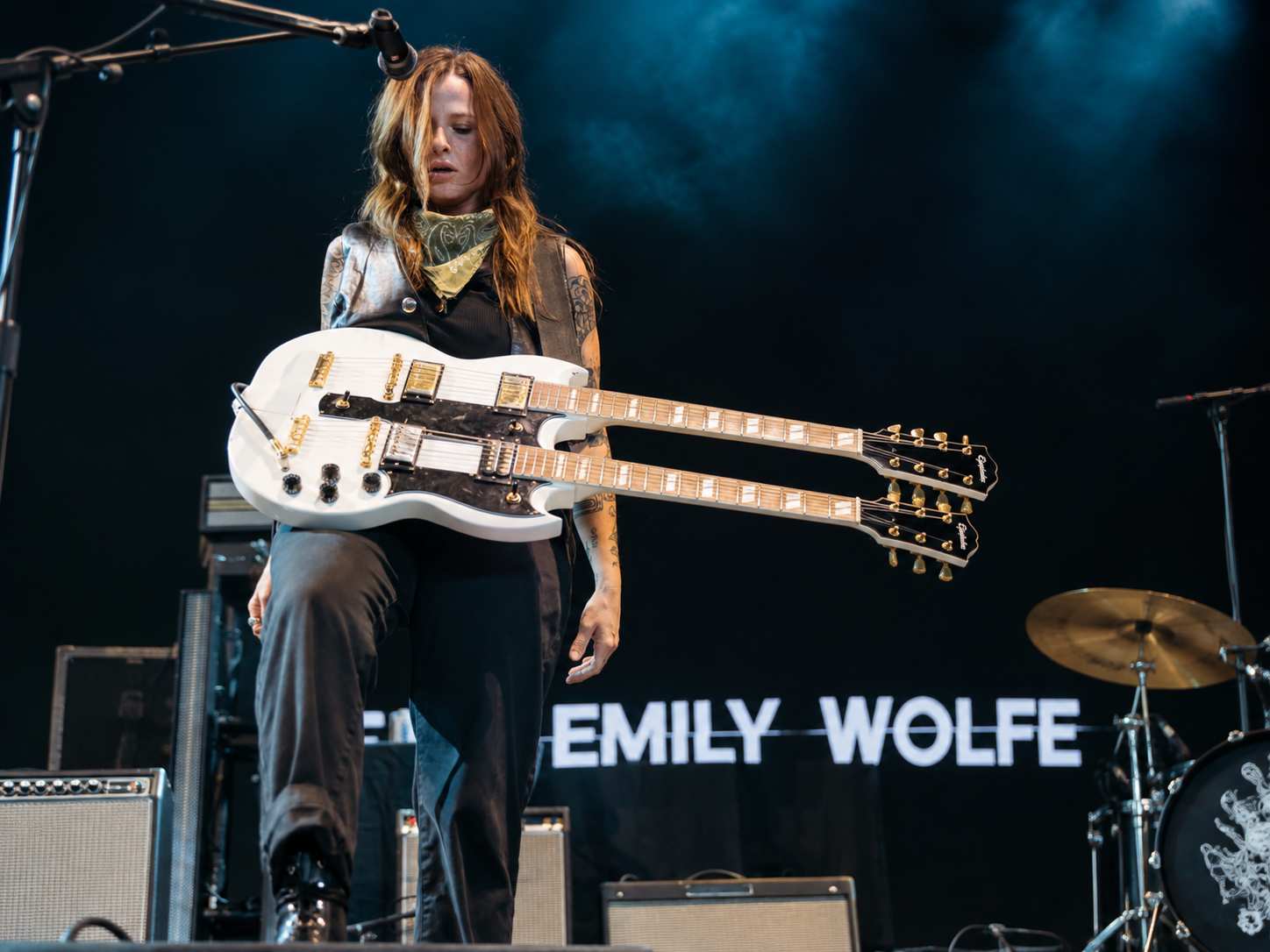
Emily Wolfe joins Press Play Radio Conversations for an in depth conversation about guitar, songwriting, musical influences, and the importance of creating a sound that is uniquely her own. From her love of classic rock tones to her appreciation for Motown hooks and the raw emotion of emo, Wolfe reveals how a wide range of musical influences helped shape the artist she is today.
Building a Sound of Her Own
For Wolfe, guitar tone is a major part of her identity as an artist. She points to four albums in particular as examples of guitar tones that continue to inspire her: Led Zeppelin II, ZZ Top’s Eliminator, a Jimi Hendrix album, and Black Sabbath’s Paranoid. She explains that the tones on those records helped make the songs what they are, particularly the way fuzz and overdrive were used to create sounds that still feel distinctive decades later.
That appreciation for classic guitar sounds also influences the way Wolfe approaches her own equipment. While digital technology has come a long way, she says she still prefers individual pedals that allow her to tweak her sound while performing. For Wolfe, that hands on approach is part of what makes playing guitar fun.
From Classic Rock to Motown and Emo
Wolfe’s musical influences extend far beyond guitar driven rock. She describes growing up listening to classic rock through her father, including The Who, Creedence Clearwater Revival, Tommy James and the Shondells, James Taylor, Black Sabbath, and Led Zeppelin. Her mother listened to Motown, while her sister listened to emo music.
Then came Good Charlotte.
Wolfe remembers buying the band’s first album with her own money at Best Buy when she was around twelve. She describes hearing the music and thinking, “what is this amazing music?” Eventually, she felt like the album represented her own identity.
Those different musical worlds became part of her creative foundation. Wolfe says she fell in love with the guitar tones of classic rock, the song structures and hooks of Motown, and the raw emotion found in emo music. As she got older, she began exploring blues and guitarists such as John Mayer, B.B. King, and Derek Trucks.
The Search for a Signature Sound
One of the strongest themes throughout the conversation is Wolfe’s desire to develop a sound that listeners can immediately recognize as hers.
She talks about hearing artists such as Stevie Ray Vaughan and being fascinated by the idea that you could recognize a guitarist simply from the way they play. That became something she wanted for herself.
“I wanna have a sound where people know it's me playing when they hear it,” Wolfe explains.
Rather than chasing whatever happens to be successful at the moment, Wolfe says she would rather “pave my own way.” She acknowledges that creating your own path is harder, but believes it is ultimately more interesting.
The Story Behind “Power”
Wolfe’s latest single, “Power,” became one of the major focuses of the conversation. She explains that the song came from an especially honest songwriting exercise with producer Gavin Brown, who encouraged her to strip away outside expectations and ask herself what she really wanted.
Her answer became the foundation of the song.
“I was like, power, sex, honey, flesh,” Wolfe recalls.
For Wolfe, “Power” is about being willing to openly acknowledge the desire to feel powerful and in control. She says she initially felt afraid to say those things, but ultimately decided that if those feelings are part of being human, there was no reason to hide them.
The song also reflects the difference between Wolfe’s personality off stage and the person she becomes during a performance. She describes herself in conversation as relatively calm and agreeable, but says the stage gives her a place to remove her inhibitions and unleash a completely different side of herself.
Making Other Music Her Own
Wolfe also discusses her approach to covers, including her rock interpretation of Billie Eilish’s “Ocean Eyes.” Rather than simply reproducing the original, she transformed the song through her own guitar driven style.
That ability to reinterpret music connects directly to her larger philosophy as an artist. Wolfe is not interested in simply recreating sounds that already exist. She wants to take inspiration from the music she loves and turn it into something personal.
Life on the Road
The conversation also touches on Wolfe’s experiences performing alongside other artists. She recalls sharing shows with Yungblud and being amazed by his energy on stage and the way he connects with his fans. She describes his presence as “otherworldly” and says watching him perform was a memorable experience.
When Tina asks about the most recent concert Wolfe purchased tickets to attend, she names Franz Ferdinand at Stubb’s Outdoors. She remembers being struck by how theatrical the band was live and particularly by the presence of its frontman.
A Guitarist’s Dream Setup
When asked what guitar and amplifier she reaches for when she needs inspiration, Wolfe points to a 335 that she loves. The guitar has a P90 pickup in the neck, a Bigsby, and even has “bad bitch” written on the plate where “custom made” would normally appear.
Her preferred amplifier is a 1990s Fender Concert Reverb that she found through Craigslist. Wolfe describes the guitar as particularly inspirational despite the Bigsby being difficult to keep in tune.
Music as a Way Through Tough Times
One of the most unexpected moments of the interview comes when Tina asks what music Wolfe turns to during difficult times.
Her answer is not classic rock or blues. It is pop music, particularly artists such as Ariana Grande.
Wolfe explains that listening to pop helps get her out of her own head. Instead of focusing on whatever difficult situation she is experiencing, she begins analyzing the production, instrumentation, lyrics, and emotional relationship between all of those elements. She describes the process as almost becoming a form of meditation.
A Career Filled With Big Moments
Near the end of the conversation, Wolfe reflects on some of the remarkable artists she has had the opportunity to work alongside. She describes Brian from The Gaslight Anthem as her best friend and shares how much she enjoys their friendship and time together on the road.
She also talks about performing with Tool and the surreal experience of having Adam Jones become a fan of her work. Wolfe says playing with Tool was “probably the coolest thing to ever happen to me.”
From classic rock records and Motown hooks to emo, blues, pop production, and modern rock, Emily Wolfe has built her musical identity by pulling inspiration from many different places. At the center of it all is a desire to create something recognizable as her own, whether she is writing an original song, reimagining a cover, experimenting with guitar tones, or stepping onto a stage and letting her most uninhibited side take over.